Well, I’m finally in the house I plan to spend the rest of my life in. It’s going to be time to begin building a layout soon.
I’ve been given a 20 by 25 foot space at the south end of my new basement I can wall-off and make theoretically cat-proof. I figure that I can help make it as cat-proof as possible by using a sliding door at the entrance to the room, and by running the drywall on the outside between the rafters.
Not really knowing when we would be moving into my wife’s childhood home, I spent part of last year painting cabooses, and making up some heavyweight passenger cars that I could use in a late 1941/mid-1942 session. I doing so, I was struck by the realization that cabooses and passenger cars looking “right” have always been a big part of what make a model railroad feel “right” to me.
I think that part of it is borne out of my interest in cabooses and passenger cars. As long as I can remember, I have been willing to spend more to accurately model cabooses and passenger cars than I have any other part of the railroad. A big part of that is that the cabooses and passenger cars are a relatively finite part of the whole layout operation. Locomotives and freight cars can continue to pile up through acquisitions, but it is far easier to set a limit on how many cabooses and passenger cars I need.
I picked 1953 and 1948 as eras for my model of the Pere Marquette’s Chicago Subdivision. I was perfectly happy to plan for those sessions, picking up about ten two-unit sets of GP7s for road power during the 1953 sessions, NW2s for local switching power and more than the PM’s dozen E7As to lead the passenger trains. I was ready to go ahead with those plans, but then my friend John Young casually mentioned that I already owned enough steam locomotives that I could model pre-WWII too. Not being one to step away from a challenge in the hobby, I took him up on that. Now I’m planning on eventually holding mid-1942, 1948 and 1953 sessions.
That makes planning a bit more involved, but given the way the PM stood up to its challenge in WWII, it looks like it’ll be worth it. Nothing like throwing more trains at a problem to solve it!
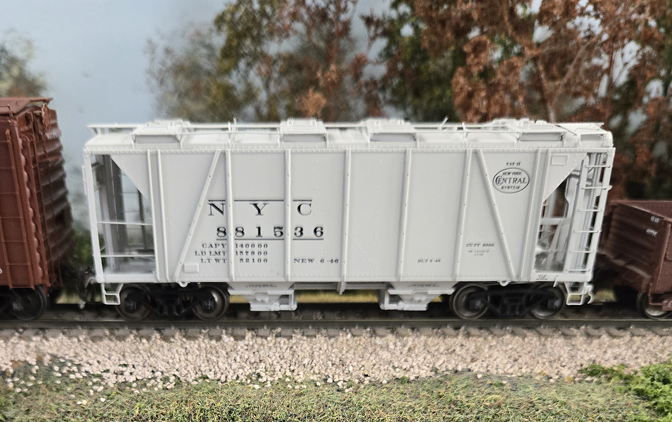
My six-pack of NYC covered hoppers arrived from Rapido last week. These will make it easier for the Big Four to serve the concrete plant at dockside along the St. Joseph River. Most of the build dates painted on the cars are during the War, so they probably will be of most use in 1948 and later operating sessions. (Photographed on the Wabash Second Subdivision layout)
-fm
 Bob’s code, along with a snippet he realized needed updating the night before we visited Dan’s, ran PERFECTLY for the twelve hours we were there of Friday, and the two and a half hours we were there on Saturday.
 One Tuesday night in what had to have been mid-November 1984, I accompanied Mike to one of the AAGN operating sessions. That session followed a soon-to-be familiar pattern- every attendee would take a position in one of about 9 towns spread around a 40 by 40-foot basement and switch out every outbound car into a road train drawn by road power. When the train was ready to depart, the local switching power would tie a caboose on an outbound train, and give it its road power. The local crew would notify the Dispatcher, then the Dispatcher would perform his computer-aided magic.