A Modeler's Blog - by Fritz Milhaupt

Author: Fritz Milhaupt

Prelude to Layout Planning

Well, I’m finally in the house I plan to spend the rest of my life in. It’s going to be time to begin building a layout soon.

I’ve been given a 20 by 25 foot space at the south end of my new basement I can wall-off and make theoretically cat-proof. I figure that I can help make it as cat-proof as possible by using a sliding door at the entrance to the room, and by running the drywall on the outside between the rafters.

Not really knowing when we would be moving into my wife’s childhood home, I spent part of last year painting cabooses, and making up some heavyweight passenger cars that I could use in a late 1941/mid-1942 session. I doing so, I was struck by the realization that cabooses and passenger cars looking “right” have always been a big part of what make a model railroad feel “right” to me.

I think that part of it is borne out of my interest in cabooses and passenger cars. As long as I can remember, I have been willing to spend more to accurately model cabooses and passenger cars than I have any other part of the railroad. A big part of that is that the cabooses and passenger cars are a relatively finite part of the whole layout operation. Locomotives and freight cars can continue to pile up through acquisitions, but it is far easier to set a limit on how many cabooses and passenger cars I need.

I picked 1953 and 1948 as eras for my model of the Pere Marquette’s Chicago Subdivision. I was perfectly happy to plan for those sessions, picking up about ten two-unit sets of GP7s for road power during the 1953 sessions, NW2s for local switching power and more than the PM’s dozen E7As to lead the passenger trains. I was ready to go ahead with those plans, but then my friend John Young casually mentioned that I already owned enough steam locomotives that I could model pre-WWII too. Not being one to step away from a challenge in the hobby, I took him up on that. Now I’m planning on eventually holding mid-1942, 1948 and 1953 sessions.

That makes planning a bit more involved, but given the way the PM stood up to its challenge in WWII, it looks like it’ll be worth it. Nothing like throwing more trains at a problem to solve it!
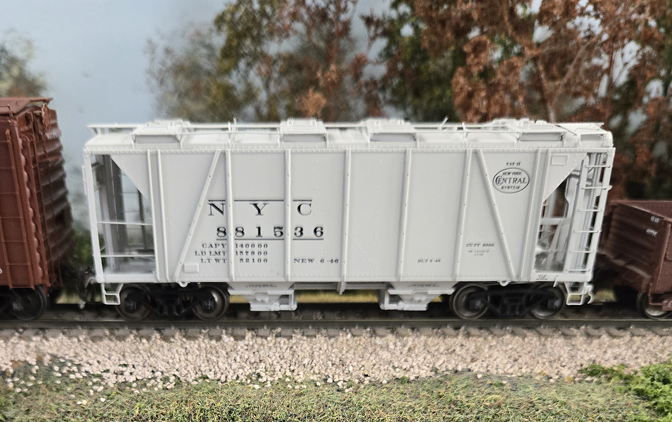

NYC Covered Hopper - Enterprise design
My six-pack of NYC covered hoppers arrived from Rapido last week. These will make it easier for the Big Four to serve the concrete plant at dockside along the St. Joseph River. Most of the build dates painted on the cars are during the War, so they probably will be of most use in 1948 and later operating sessions. (Photographed on the Wabash Second Subdivision layout)

-fm

Handling This Year’s Changes

A number of changes have happened in my life recently. Firstly, I closed down my post office box of nearly forty years. I figured that with my no longer selling decals, and the fact that it was now well over $100 per year for the privilege/hassle of collecting my own mail in a downtown building, that money was no longer well-spent.  My box was in a post office that shared its building with the area Federal Court and its inherent security. This reduced the hours I could access it, so it no longer felt necessary to have a stable address that has outlasted a dozen moves.

The second big change is that I have moved into the house I will likely spend the rest of my life in. Beginning construction of my “lifetime layout” is now possible. Especially since a third big change occurred- the Operations Road Show name and responsibility that I and a few friends took on in the late 1990s has been handed over to a group of Free-Mo N scalers as of mid-July 2025. The HO Wabash layout we built to support this still exists and consumes my Wednesday evenings and one Sunday a month. What this means is that since 1997 I have been actively a Wabash and Monon modeler in HO scale. This has gotten very much in the way of my modeling the Pere Marquette. No longer.

In the process of packing for the move across town earlier this year, I was made aware of just how much I have accumulated in the way of non-PM HO equipment as well as non-HO stuff. This will be on sale tables that I have purchased this Fall across Southeast Michigan.

Another change has been building over the past 26 months. I have decided, finally, that the tepid response to the more than three hundred resumes that I have submitted to companies since Ford sent 1,000 of us packing in mid-2023 is enough to justify my considering changing careers. I haven’t figured out quite where that means I will land yet. I’m still working on that. I certainly don’t feel that I want to drive 35+ miles to work any more, unless there’s a helluva lot of money involved. Nobody wanted a 57 year-old who was good at technology, and there is even less demand for a 59 year-old, even if he’s picked up a few new skills.

I don’t know what I’ll be doing to be a year from now. Hopefully I’ll have at least started on a new layout in the current house. What I was doing before brought me a lot of money up until it didn’t. Money doesn’t buy happiness- yeah, we’ve all heard that before. But being a life-support system for a resume nobody wants to read doesn’t make me feel all warm and fuzzy, either.

-fm

I’m So Proud

I spent most of the past weekend at an annual “Danathon” where about 30 people celebrate the birthday of a former BNSF Yardmaster of BNSF’s Eola Yards, about an hour west of Chicago. Over the past two years, my brother, Bob, has been working with JMRI and LOGIX to help with establishing the rules and animating the signals and CTC panel indicators for Dan’s layout, which represents the Twin Ports of Superior, Wisconsin and Duluth, Minnesota, shortly after the BN merger, in 1970.

BN Herald width= Bob’s code, along with a snippet he realized needed updating the night before we visited Dan’s, ran PERFECTLY for the twelve hours we were there of Friday, and the two and a half hours we were there on Saturday.
I contributed nothing to his code, but all the same I’m proud of the work that Bob has done for Dan. He helped achieve one of Dan’s major goals for his railroad. He also made the new upstairs Dispatcher’s Office operational which allowed another member of Dan’s operating crew to participate, in spite of layout access problems resulting from a number of medical procedures in recent years.

Bob’s efforts are the stuff that has made a couple of people’s dreams reality.

I’m more than a little proud of him.

-fm

A Fresh Start

Finally- I got the PMHS Periodicals page up to date- I promised myself I wouldn’t do any more with the blog until the PMHS web site was updated…

We’ve turned the corner and moved into what I hope will be the last house we will live in- the house my wife, Leslie, grew up in. We moved in at the beginning of the year to be able to more readily help out her mother, who celebrated her 90th birthday two weekends ago and is beginning to feel some signs of her age. It was a move of a whole 4.5 miles due north.

As far as building my “lifetime layout” this is it- I was given a 20- by 25-foot section of the south end of the basement to wall off and build my layout. While I would love to have the entire basement to build the layout, there is an element of compromise in all married decisions, and besides it keeps the layout to a size that I will be able to reasonably complete within another 30 years.

I’ve decided to take an unusual tack with designing my layout- I’ve asked the guys who make up my expected crews what features they’ve liked the most about layouts we’ve worked on in the past, and decided that I will tailor my new layout to their interests as well as my own. Of the half a dozen guys I have spoken with who participate in the regularly scheduled TT&TO operating sessions on the Wabash layout, I came away from the conversations with a definite bias in favor of a layout with lots of switching and far less mainline operation.

The major theme is one that I firmly control- the Pere Marquette in western Michigan at the very end of its independent existence. This places the PM, as I model it, squarely in the 1940s. I like the more modern steam power- for example the Berkshires- and like the early diesels. Fortunately the PM was the one portion of the C&O system which dieselized early with SW1 and NW2 switchers.

Given that I have a 20 by 25 foot space, I’ve gone through some basic layout planning exercises with John Young. In just placing the various crew members around the space and applying the minimum main line radius, I found out that I cannot possibly fit 30 miles of HO model railroad in a space so small and a still fit a dozen crew. A four-person crew is much more reasonable in the space I have. The 30 miles of track is straight out, no matter how I carve up the space.

A four-person crew also better fits into an around-the-room layout design with the crew lounge in the middle, using some of the furniture we brought with us from the south side of town.

The sole trade-off in the design is that in as much as I love timetable-and-train-order operation, I will only be able to fit two offices issuing train orders on the layout, each about a scale mile from the other. As a result, we probably won’t be able to justify two operators. The reason for these two offices, I’ll leave until some future time.

-fm

Roots – 2 (Switching the AAGN)

During my high school years, I turned an early interest in microcomputers into an after-school job. As pretty much the go-to programmer for the Grand Rapids Urban League, I turned  that job over to my brother Bob when I went off to school. During those years I accepted a job at Stan’s Roundhouse where I sold model trains on weeknights and weekends.

A work-study position at the University of Michigan’s Center for Research on Learning and Teaching gave me early access to the Internet, about ten years before the general public got onto it. Most importantly, it introduced me to M-Net, a little BBS run by Mike Myers in the Ann Arbor area. Mike was working with a programmer, Marcus Watts, to try selling a Unix-based BBS-system to companies to use in-house and for technical support. I took a role in promoting his dial up BBS, including placing a notice in Model Railroader. We got a whopping two new members from that effort. Dial-up (only) access and long-distance bills were a big factor here.

Mike had gone through a model railroad phase, and still had a nicely-detailed HO model railroad on benchwork running around the living room of his condominium, the Petoskey, Boyne Falls and Gaylord.  Being familiar with the prototype Boyne City, Gaylord and Alpena, this road felt very familiar to me.  He regularly ran on a local model railroad known as the Ann Arbor Great Northern. The AAGN ran alternate Tuesday nights in the basement of its owner’s home. Its owner was local ear, nose and throat surgeon, Dr. Jerry Butler.

It was on the AAGN that I got my first taste of operation. Little did I know where that was to lead me.

Great Northern (prototype) heraldOne Tuesday night in what had to have been mid-November 1984, I accompanied Mike to one of the AAGN operating sessions. That session followed a soon-to-be familiar pattern- every attendee would take a position in one of about 9 towns spread around a 40 by 40-foot basement and switch out every outbound car into a road train drawn by road power. When the train was ready to depart, the local switching power would tie a caboose on an outbound train, and give it its road power. The local crew would notify the Dispatcher, then the Dispatcher would perform his computer-aided magic.

The central piece of the AAGN was its Apple ][, interfaced to a relay board which threw switches and engaged power on the “outbound” track of a selected town. This was ten years before digital command control began to make itself known, so any train that ran was controlled like any simple train set locomotive, by voltage applied to the rails from a rheostat at the Dispatcher’s side.

As Dispatcher, Dr. Butler would run the outbound freight to a six-track receiving yard at Northtown where a hump engine (generally a cow-and-calf set) would take the cars from the train and push them to the top of the hump. At the peak of the hump, the hump crew would select one of twelve tracks using a selector similar to the buttons on a car radio and sort the car onto a designated track. Slowing down the cars was by draggung the card card against the car’s roof to slow it down.

Once a track was full, the Departure Yardmaster would  pull the cars on the track to the Departure Yard where he’d restore the road power and caboose. After making certain that the train’s paperwork was all in order, he would call the Dispatcher to use the computer to take the train to where it would be delivered to be switched inbound by its local crews as its third part of the session. When each town has completed switching the inbound cars, the session ends.

After running on the AAGN for the first time, we struck up a conversation with Skip McDonald who had a regular position running the receiving yard that took incoming trains and prepared them to be sorted on the Northtown hump. After the session, Skip invited us to see his Mackinaw and Western layout. Skip was to play a big role in my hobby. More on that next time.

-fm

Roots – 1

From a very early age, I’ve looked forward to being able to build a “lifetime layout”. This would be a big model railroad that would take decades to complete, the kind of grand, multi-operator basement-filler that has been the subject of so-many articles in the model railroad press over the past fifty years. To date I’ve worked on a number of other model railroading projects, but until now haven’t really started work on the “lifetime layout”.

My brother and I started our first HO layout when were in junior high school and worked on it, off and on, until we went off to college. This was a freelanced model of the Chesapeake & Ohio in a vaguely West Virginian setting built into a ten by fifteen foot space at one end of the basement playroom. We built it very much on the cheap, with scrap lumber, reclaimed wire and a lot of hand-laid track to keep the costs down. Bob became quite skilled at hand-laying turnouts. One that stands out was an impressively-long number 14 turnout that lead into the caboose track in our large stub-ended yard.

The track plan was pretty much that stub-ended yard feeding into a loop that circled an operator’s pit three times at various elevations before returning to the yard- very much a typical 1960s design built in the early 1980s. While there were a few customer spurs off the mainline, there wasn’t much to do other than run a single train in circles. We later added a branchline off of the mainline onto a stretch along one wall, but we were losing interest and didn’t develop it very much. We never got around to filling in any scenery around its open-grid benchwork.

After we each went off to college, it sat in our parents’ basement for a couple of years until we took it down, then our father built a Lionel layout in its place.

-fm

Getting Started

If you are looking for general information on the Pere Marquette Railway, I recommend heading on over to the Pere Marquette Historical Society’s web site. This blog is going to be very specific to my efforts to model the Pere Marquette Railway in HO scale, so it is not necessarily going to be a good general-reference site.

After several decades of working on modular layout-based projects, I am approaching the time when I will be able to build my so-called “lifetime model railroad”. When that time comes, I intend to have it sufficiently well-planned out that I have few questions as to how to proceed.

This site will document my process on planning it all out. I cannot commit to any kind of regular cadence for updates, given the amount of my hobby time that I still have committed to other projects. We’ll just have to see how this goes and whether there will be enough content here to make this blog a viable effort.

– Fritz Milhaupt